
25. September 2025 | Allgemein

Export Controls on Gallium and Germanium: China Wants to Negotiate

Written by Sabrina Heimrich

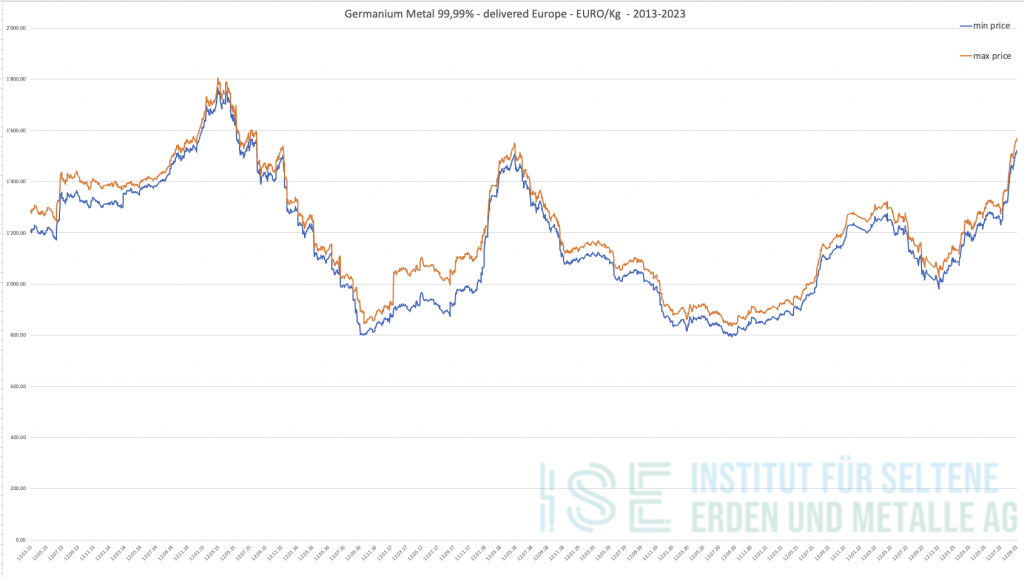
Chart Germanium metal 2013 bis 2023

Chart Germanium metal 2013 bis 2023 

Germanium metal 99,99% delivered Europe - Source: ISE AG


China’s Export Controls on Gallium and Germanium Send Shockwaves Through Global Markets

The export controls imposed by China in the summer on the high-tech elements gallium and germanium sent shockwaves through the global economy. Yet, according to a China expert, the move was not meant as an escalation, but rather as a tactical maneuver to gain leverage in the ongoing technology war.

In 2022, global production amounted to just 430 tonnes of gallium and 225 tonnes of germanium. Despite these relatively small quantities, the export restrictions introduced by China in August caused widespread alarm — largely because of the critical role these elements play in high-tech applications and the extreme concentration of production in China.

The dominance is particularly striking for gallium:

“Of the 430 tonnes produced worldwide, only ten were made outside China. It is the strongest monopoly that exists for any element on the planet,”
explains Alastair Neill, China specialist and critical minerals expert at the North American Critical Minerals Institute.

As a result, China now accounts for nearly 98% of global primary gallium production and an estimated over 80% of primary germanium output.

Key Role in Semiconductors and Optoelectronics

Gallium arsenide is used in high-performance chips and semiconductors. Gallium also has the unique ability to convert electricity into light, which makes it indispensable for optoelectronics — crucial for 5G technology and ultrafast fiber-optic networks.

The element is also used in smartphones, solar cells, and satellites. Although much more expensive than the widely used semiconductor silicon arsenide, manufacturers such as TSMC and Compound Materials (based in Saxony, Germany) rely on gallium arsenide for its superior performance.

Bargaining Power in the Technology War

Beijing justified the export restrictions on the grounds of national security. According to Michael Harz, CEO of Compound Materials, Chinese authorities are now requiring end users and importers to specify details such as the intended use, final users, and applications of gallium products.

Harz does not believe that China seeks escalation, noting that China itself reimports processed gallium products.

Neill, who worked in China for seven years, supports this view:

“This allows China to effectively control where its gallium goes.”

He sees the move as strategic calculation, pointing to the U.S. ban on exporting chipmaking equipment to China, which has significantly slowed the development of China’s 5G infrastructure. With the gallium and germanium export controls, China is likely trying to create bargaining leverage in its tech standoff with the United States.

U.S. Caught Off Guard

The United States was caught off guard by the new export rules.

“While the U.S. government holds germanium reserves, it surprisingly has none for gallium,”
Neill notes.

By contrast, Compound Materials in Saxony reportedly has reserves sufficient for six months, according to German broadcaster MDR.

Economically, the pure gallium metal market is tiny — around USD 100 million annually — meaning a temporary drop in Chinese exports would have little macroeconomic impact. However, because of its small size and specialized nature, the market offers little incentive for companies to invest in new mining projects.

How Gallium and Germanium Are Produced

According to the German Mineral Resources Agency (Dera)germanium is mainly obtained during the smelting of zinc and copper sulfide ores, as well as from coalGallium, meanwhile, is a by-product of aluminum or zinc production, with bauxite being the most significant source, accounting for around 90% of global output.

In 2022China was the world’s second-largest bauxite producer, after Australia, and is therefore able to meet its domestic demand. The West African nation of Guinea, home to the world’s largest bauxite reserves, also ranks among the top three producers.


Gallium Metal 99,99% FOB China - Source: ISE AG


Resumption of Gallium Production in Germany

Among the five largest gallium importers are the United States, India, Japan, South Korea, and Taiwan. According to the German Mineral Resources Agency (Dera)Germany imported between 40 and 60 tonnes of gallium annually from 2020 to 2022, with 50 to 60 percent coming from China. The remainder was sourced mainly from Slovakia.

The Slovak company CMK, founded in the 1970s in the small town of Žarnovica, produces gallium and gallium arsenide using proprietary recycling processes.

Until 2015Ingal Stade GmbH, a Germany-based company, was the largest gallium producer outside China. Its facilities were located on the grounds of Aluminium Oxid Stade GmbH (AOS Stade). However, due to a sharp decline in gallium prices, Ingal Stade ceased production in 2016 and was subsequently dissolved.

When gallium prices rebounded in early 2021AOS Stade announced plans to resume gallium production alongside its aluminum operations by the end of 2021. Yet, this has not happened to date, and the company declined to comment on the current status when contacted by the Institute for Rare Earths.

Bauxite from Conakry to Stade

In 2022, the Neues Stader Wochenblatt reported that AOS Stade had applied to the Lüneburg Trade Supervisory Officeto raise the embankments of its red mud disposal site from 16.5 to 30 meters, although the current maximum permitted height is 21 meters.

The disposal site lies about four kilometers west of the Elbe River, near AOS Stade’s production and port facilities. The company sources its bauxite from Guinea, a country that has been under military rule since a coup in 2021 that ousted President Alpha Condé, who remains under house arrest.

AOS Stade’s parent company is Dadco, an aluminum group owned by British-Canadian businessman Victor Dadaleh, whose corporate headquarters are registered in the Channel Islands.

Dadco holds a 10 percent stake in Halco Mining, which in turn is a shareholder of the Compagnie des Bauxites de Guinée (CBG) — one of Guinea’s two largest bauxite producers.

Western Supply Still Uncertain

Although Canada, the United States, Belgium, and Russia also produce gallium and germaniumDera concludes that these countries cannot meet global demand, at least not in the short or medium term.

China’s export restrictions currently remain controls rather than outright bans, emphasizes Dera expert Maren Liedtke, who warns against unnecessary panic.

At the same time, the West lacks China’s ability to collect and process bauxite from multiple sources at centralized facilities — a key factor behind China’s dominance in gallium production.

“That kind of coordinated cooperation just doesn’t work as well here in the West, where every company tends to operate on its own,”
explains Alastair Neill.

← BACK TO OVERVIEW