
ISE certification
The Institute for Rare Earths and Metals is active in a niche market. We store, inspect, analyze and evaluate Rare earths and metals. As in so many other niches, there are few and no uniform standards in this segment. ISE AG has therefore set itself the task of establishing a uniform certification for all Rare earthsto create secondary metals, base metals and isotopes and to develop them continuously. This certification is intended to give sellers the security to know what they offer. Buyers, banks and other financial institutions receive accurate answers to the questions with an ISE certification: who, what, how much, where, where, when and in what quality. Since we are home in a small, very individual segment, we are going to answer very individual questions both for the seller, the buyer and the auditor and help with expert interviews. We take this knowledge into our standards to leave no questions unanswered in the future.

The building blocks of ISE certification are
The ISE inspection
There are two types of inspections carried out by the ISE. If there is no package list, a full inspection must be carried out. Here, each box is opened, each bottle / spool / barren etc. numbered, weighed and photographed. The data are recorded in a newly created table. If a package list is already available from the customer, the ISE usually performs a “cross inspection”. In this more favourable alternative to full inspection, the ISE inspector selects box and unit randomly to measure their weight and then the ISE inspector selects it with the compare the corresponding value in the package list. The documentation is carried out as well as in full inspection. The inspection report is a 20- to 100-page document, depending on the extent of the goods, which provides accurate information on the inner and outer conditions of the packaging and the goods to the Each unit is listed with the photos and numbers taken and thus a reliable picture of their quantity is given. Each unit and box are numbered during the inspection and sealed at the end.
Sample taking
The sampling
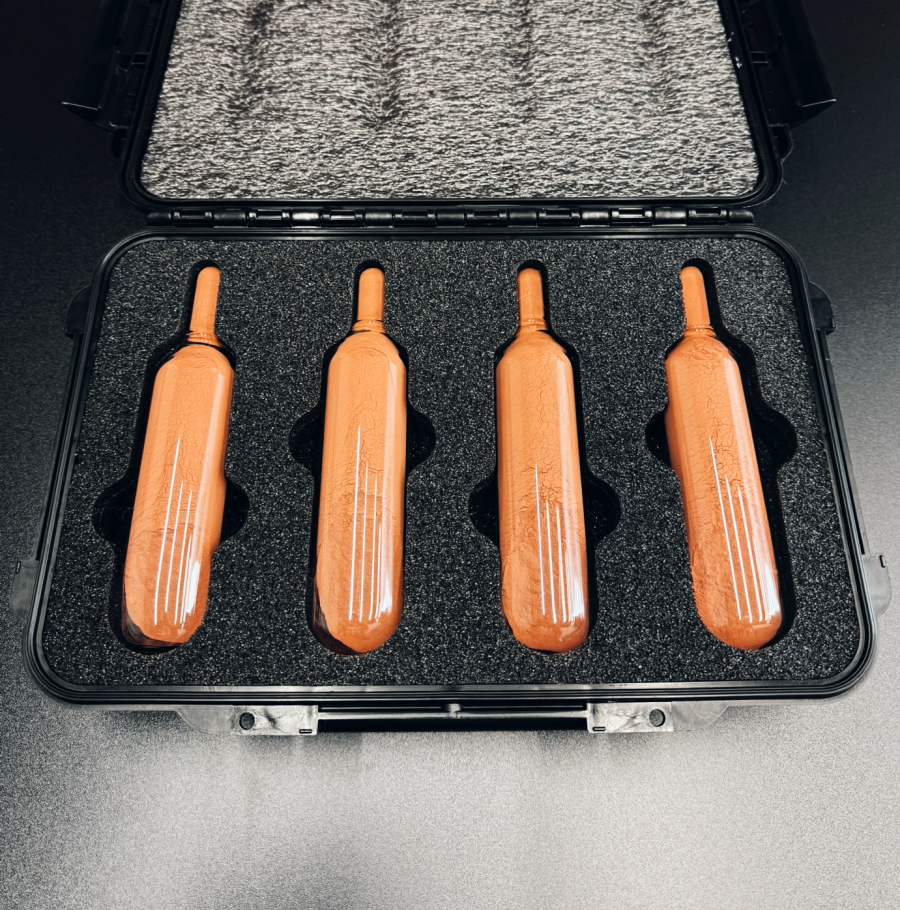
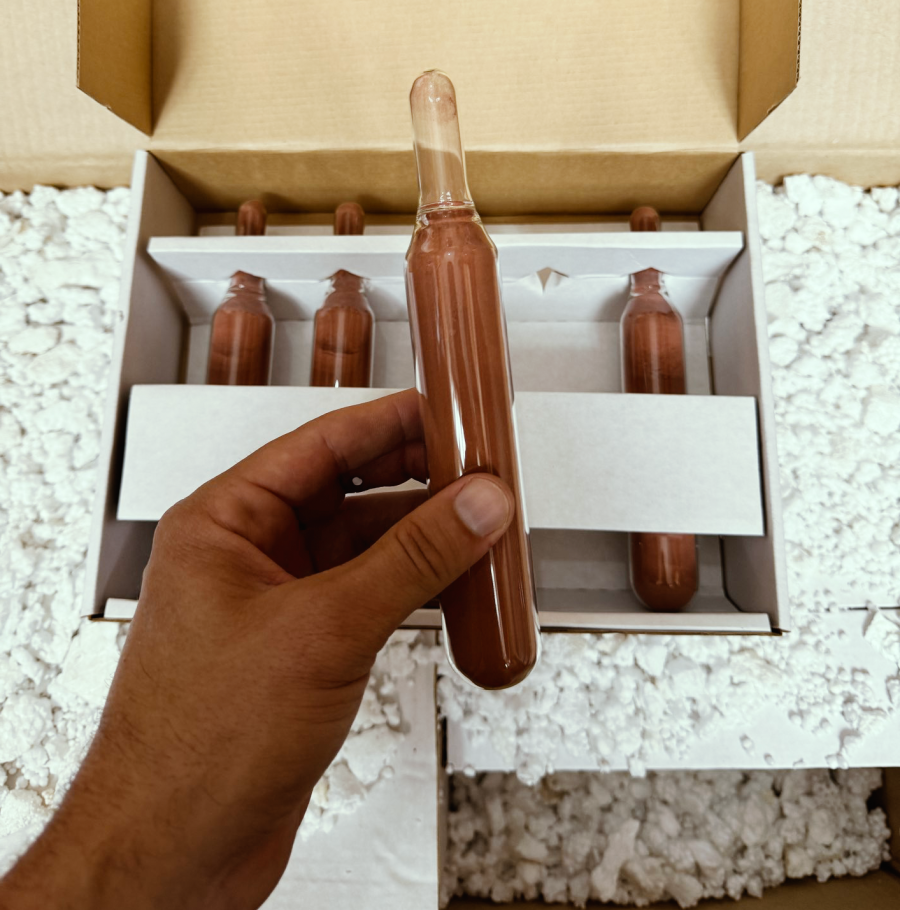
Sample taking records who collected which sample, when and where, how it was collected and which standard was followed. The sampling protocol assures the future owner or auditor that the sample came from the exact lot stored in the warehouse and covered by the inspection report. Many products require specialist handling. Nanopowders, for example, are often packed under protective gas to prevent oxidation. Argon is heavier than air and remains in an upright open bottle, but can escape when the bottle is tilted. Sampling should therefore always be performed by a trained inspector. Depending on the quantity of goods, the protocol contains 8 to 36 pages with photographs and precise details of the box and unit from which the sample was taken.
The analysis
The samples are sent by the ISE inspector to the ISE laboratory by courier. Homogeneous metals are tested by the ISE with one of three GD/MS units, soil samples are usually tested with RFA and ICP-OES, non-homogeneous metals and isotopes with ICP-MS. Furthermore, there is also a scanning electron microscope with a maximum of 25,000 times magnification. The laboratories are certified according to DIN EN ISO 9001:2015; accreditation according to ISO 17025: is in preparation. The chemists working for the ISE are members of GDCh and GDMB. The laboratories regularly participate in ring tests by renowned institutes.

GD-MS Analysis

The assessment
ISE has developed its price databases since 2011. Together they now contain more than 21,000 prices for metals and metal products in different qualities and from different delivery locations. One database Database around 900 Prices of pure metals and the second about 20,000 Prices the metal products that are imaged in real time. These databases are the basis for all ISE prices. The ISE price databases are publicly accessible on the Internet and can be used for a fee.
The Prices the metals are divided into two databases for good reason. In the ISE database 1 there are Rare earths, by-metals, base metals, steel raw materials, stainless steel metals, strip steel, ferroalloys and refractory metals. All these metals are pure metals, the price of which can be reckoned linearly by quantity. In the ISE database 2 there are metal products from all metals of Aluminium to zirconium. These are synthetic products and therefore their price curve is degressive.
In pricing we follow the rules of various stock exchanges. Thus, a rule of thumb states that a meaningful price could only result from the average of at least six price indications within three months. The problem of ultra-environmental markets such as those in some metal products is that no six indicators for larger quantities are available within three months. to be found. Therefore, we offer our customers the price of the smallest unit. This is usually a gram, a milligram or a meter that cannot be scaled linearly, as it is a degressive price course. If the price of a whole batch is desired, we offer the possibility of Audit for your individual needs.
The Reviews of the ISE are globally accepted (except in Cyprus). With references to inspection, sample taking, analysis and depot certificates, an assessment of the ISE is the conclusion of a complete documentation of its goods. The ISE always answers verification queries of the documentation very quickly, as the employees of ISE knowthat their customers often prefer sporty timing. Questions that remain with the addresseee are very much answered by the ISE on behalf of their customers.
The depot certificate
The warehouse receipt, also known as a Safe Keeping Receipt (SKR), documents the goods stored for you in our bonded warehouse. It identifies the goods by referring to the inspection report, sampling protocol, analyses and valuation. The holder of the receipt does not have to be the ultimate beneficial owner (UBO), but is authorised by the UBO to sell the stored goods or complete a comparable transaction.

Certificate of Ownership
The property certificate
The property certificate is issued only once - as a hardcopy - by the ISE and is the ultimate property certificate that certified the UBO. The property certificate is only changed by ISE when the goods are sold.