Rare earths: China firmly in the saddle despite millions invested by the Pentagon
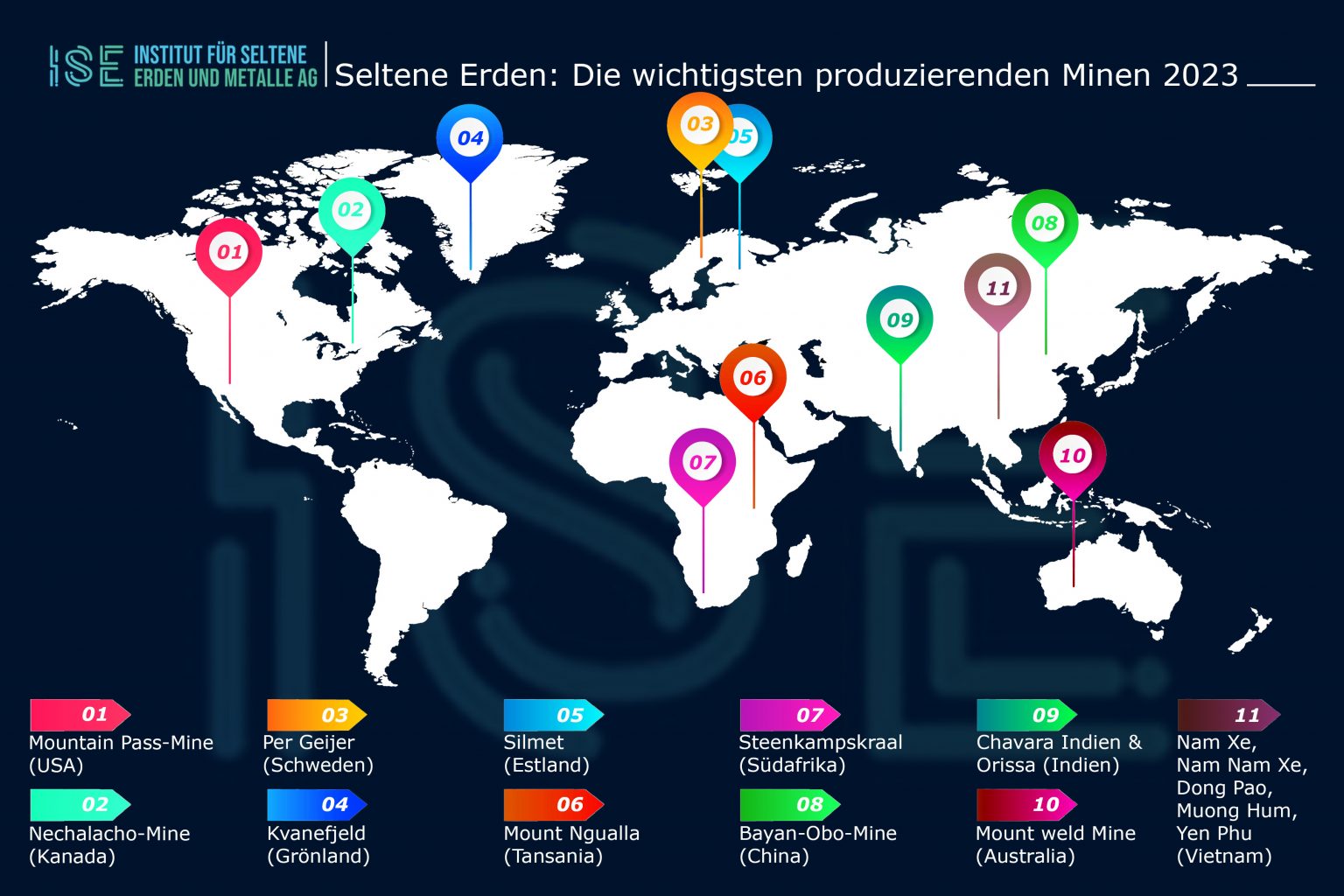
THE MOST IMPORTANT MINES IN PRODUCTION 2023 - Quelle: ISE AG
CHINA STRICTLY GUARDS ITS DOMINANT POSITION IN RARE EARTH METALS AND THE MANUFACTURE OF PERMANENT MAGNETS, WHICH ARE RELEVANT FOR CLIMATOLOGY AND THE MILITARY. AN ASIA EXPERT WARNS THAT CHINA IS EXERCISING INFLUENCE OVER THE STILL BARELY EXISTING WESTERN INDUSTRY THROUGH HIDDEN CONNECTIONS.
Mike Pompeo Opens Rare Earth Industry Congress in Barcelona
At the end of June, Mike Pompeo traveled to Barcelona — not to admire the artistic works of Antoni Gaudí, but to open the annual congress of the Rare Earth Industry Association (REIA). The former CIA director now serves as special advisor to USA Rare Earth (USARE). Previously, he was Secretary of State under Donald Trump, who in September 2020 declared a national emergency, citing the “unacceptable dependence of the United States on foreign adversaries for critical minerals” — meaning China — as an “extraordinary threat.”
Although Trump is no longer president, his critical minerals policy is being continued by his successor, Joe Biden. Of the 35 materials deemed critical to the United States, the rare earth elements stand out most. These are also considered critical by the European Union. But why all the fuss over this group of 17 elements, usually found in tiny amounts in speakers, screens, glass, alloys, and hard drives? The reason is that, with the massive expansion of climate technologies, demand for rare earths is expected to increase exponentially — particularly for permanent magnets, which are essential components of electric vehicles and wind turbines.
Dangerous Dependence on China
China controls the global supply chain for rare earth mining and processing, right up to the production of permanent magnets. This dominance has become a growing problem for Western countries, as China frequently restricts exports— most recently in spring, in retaliation for export bans on semiconductor technologies imposed by the U.S., Japan, and several EU states. China has since also tightened export restrictions on gallium and germanium. (We will report on this in detail separately.)
This dependence is particularly frustrating for the United States. Until the 1980s, the U.S. was the world’s leading producer of rare earths. “But China pursued an aggressive economic policy, flooding the global market with rare earths to drive out competitors,” Trump’s 2020 decree stated. Today, the U.S. imports about 80% of its rare earths from China.
Even the know-how for permanent magnets originally came from the United States — and is now being painfully rebuilt after decades of outsourcing to China. One company working on this is Pompeo’s USA Rare Earth (USARE), which aims to establish a fully integrated production chain — from mining to finished permanent magnets — in Texas.
Tesla Moves Away from Rare Earths
Despite U.S. and EU efforts to regain control over rare earth production and downstream industries, more and more manufacturers are moving away from permanent-magnet-based electric motors. The reasons include extreme price volatility, potential shortages, and the environmental damage caused by mining.
BMW, for instance, has eliminated neodymium-iron-boron magnets from its fifth-generation electric motors. Nissanand Renault plan to reduce the share of motors using permanent magnets. Tesla, the market leader in electric vehicles, has gone even further — its next generation of electric motors will contain no rare earths at all.
In the wind energy sector, turbines using permanent magnets still make up only a small share of Germany’s installed capacity. However, in the offshore segment — where durability and efficiency are paramount — magnet-based modelsare gaining ground. Which generator type will ultimately dominate remains uncertain, but raw material security has become a major concern. Notably, German manufacturers of permanent magnets have recently scaled back their activities — with Enercon, the leading producer of onshore wind turbines, being a rare exception. These developments show that climate technologies are not necessarily guaranteed demand drivers for rare earth elements.
Neither Clean nor Transparent
Both the wind and electric vehicle industries promote an image of clean energy and mobility. Yet, the extraction of rare earths and the production of permanent magnets are often neither clean nor transparent. The origin of rare earth elements used in magnets cannot be reliably traced.
China’s monopoly over rare earths was built in part on decades of weak environmental standards, which made its products unbeatably cheap. The environmental hazards include the release of radioactive substances such as thorium and uranium, and highly polluting mining methods, especially for heavy rare earth elements.
Thousands of Toxic Ponds in Burma’s Conflict Zones
Across the southeastern Chinese province of Jiangxi, the landscape is dotted with thousands of small, round ponds filled with toxic water — remnants of the chemical leaching used to extract rare earths. Ammonium sulfate and ammonium chloride were injected directly into the ground to dissolve the desired materials. Environmental rehabilitation could take up to 100 years, with cleanup costs estimated by the Chinese government at USD 5.5 billion.
Since 2016, the Chinese government has tried to get these environmental problems under control — closing mines, curbing production, and cracking down on illegal operations. Yet, as domestic output decreased, global demand did not. To maintain its refinery capacity and export dominance, China began sourcing raw materials from neighboring Myanmar (Burma). Within a few years, Myanmar has become one of the world’s largest rare earth producers, with militias linked to the country’s military regime partnering with Chinese companies to control the mines.
In March 2022, the NGO Global Witness used satellite imagery to identify 300 mining sites containing 2,700 chemical leaching ponds in Myanmar. The resulting environmental destruction and human impact have been catastrophic.
Pentagon Invests Millions
Both the U.S. and the EU have recently elevated raw materials policy to the top of their political agendas. However, while the EU frames the issue in terms of the climate transition, the U.S. approach is driven by national security concerns.
To rebuild domestic rare earth production and processing, the U.S. government — through the Pentagon — has already committed over USD 100 million in public investment. The military’s interest is clear: fighter jets and nuclear submarines require large quantities of rare earths. An F-35 jet contains about 420 kilograms, while each Virginia-class nuclear submarine — five of which Australia ordered from the U.S. last year — uses more than four metric tons.
Even before Trump’s 2020 policy push, the U.S. company MP Materials had reopened the Mountain Pass mine in 2017. However, U.S. independence from China remains far off: in the first three quarters of 2022, nearly all of MP Materials’ revenue came from sales to Shenghe Resources, a semi-state-owned Chinese company that is also a minority shareholder in the U.S. firm.
China thus dominates the rare earth industry not only as a seller but also as a buyer. As Andy Mok of the Center for China and Globalization told, “What’s unique about this industry is China’s presence at every step of the value chain, which makes it extremely difficult for other countries to enter.”
Despite this, the Pentagon has granted MP Materials USD 35 million to build a separation facility for heavy rare earths — even though the company remains partly Chinese-owned.
Would you like me to make this sound more like a professional magazine article (e.g., orstyle) while keeping the same information?
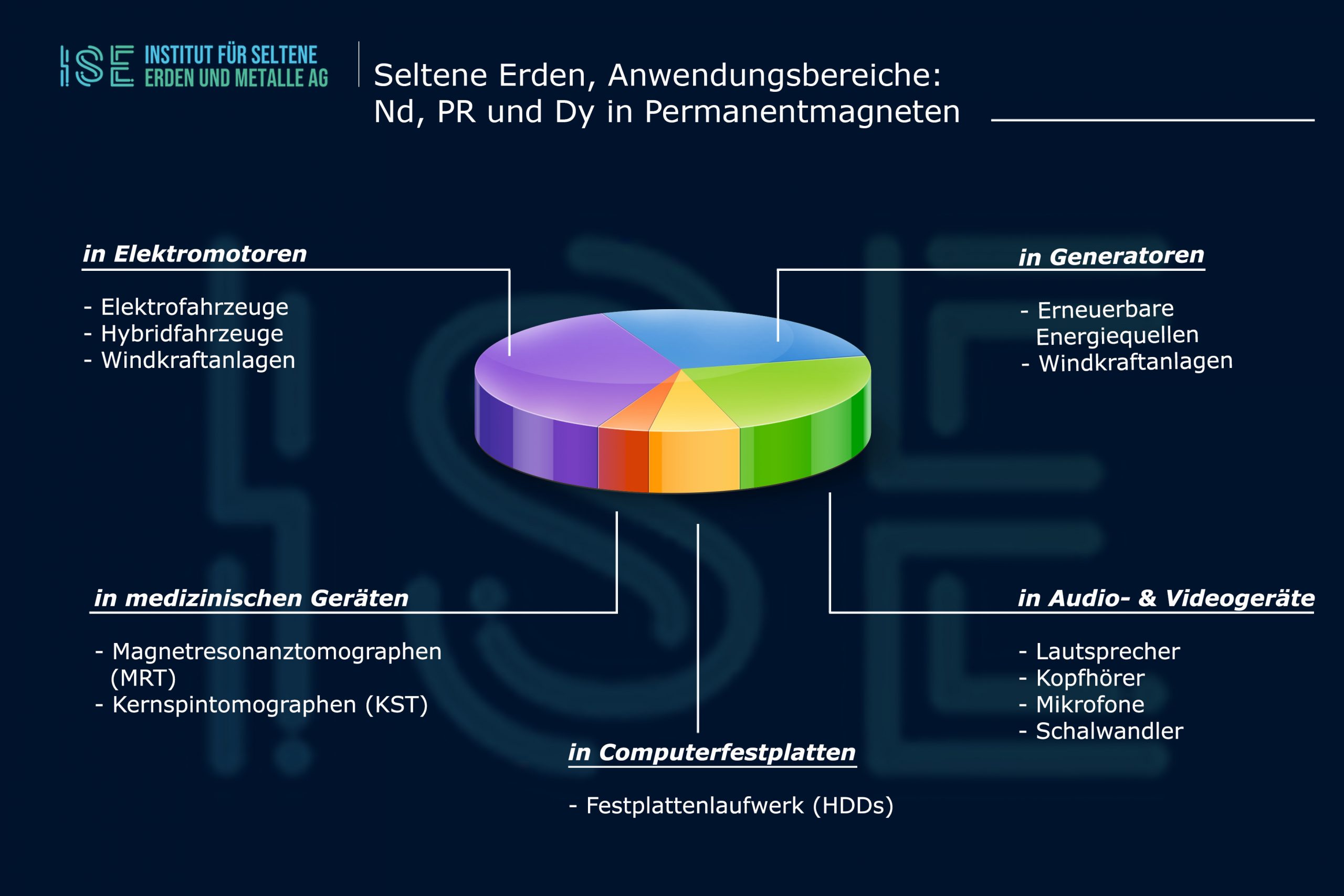
RARE EARTH METALS - APPLICATIONS OF PERMANENT MAGNETS. SOURCE: ISE AG
Separation Plants in Texas
Lynas Rare Earths is one of the few rare earth producers outside China. The company operates a mine in Mount Weld, Western Australia, and a separation plant for light rare earths in Malaysia. However, due to radioactive waste generated during the separation process, Malaysia has threatened to revoke the plant’s operating license. Lynas is preparing to shift operations to a new facility in Australia, which is almost complete.
In addition, Lynas — in partnership with U.S. chemical company Blue Line — is building its first heavy rare earth separation plant in Texas, supported by $120 million in funding from the Pentagon. Lynas is also receiving $30 million for another light rare earth separation facility in Texas.
Meanwhile, the Chinese government closely guards its monopoly over the rare earth market, built up over decades. Western efforts to regain control over rare earths have not gone unanswered. In 2009, the state-owned China Nonferrous Metal Mining Group attempted to acquire a majority stake in Lynas — a deal that was blocked by Australian authorities.
Today, according to the U.S. Department of Defense, Chinese actors are also engaging in disinformation campaigns. A hacker group called Dragonbridge, allegedly linked to Beijing, is said to have spread negative narratives about Lynas online.
In 1992, Chinese Party Secretary Deng Xiaoping famously declared, “The Middle East has oil; China has rare earths.” The long-term goal of the Communist Party has been to transition from a raw material supplier to a technological leader. Three years later, two state-owned Chinese firms, with help from the U.S. Sextant Group, acquired Magnaquench, the only American producer of permanent magnets, previously owned by General Motors. This gave China access to crucial patents.
Despite prior agreements, the new Chinese owners shut down all U.S. operations by 2000. Today, China controls over 90% of the global permanent magnet industry. According to Asia expert Frank Jüris from the Estonian Foreign Policy Institute, the close ties between China’s political leadership and industry are striking: one of the executives involved in the Magnaquench takeover was Zhang Hong, Deng Xiaoping’s son-in-law.
Hidden Connections with China
The second notable rare earth separation facility outside China is located in Estonia. Silmet, a remnant of the Soviet era, is now owned by Neo Performance Materials (Neo), a Canadian-listed company. Neo plans to expand the facilityand begin permanent magnet production.
Silmet previously belonged to Molycorp, founded in 2008 with the goal of rebuilding the entire U.S. rare earth supply chain — from mining to magnet manufacturing. Molycorp revived the Mountain Pass mine and repurchased Magnaquench from the Chinese. However, Molycorp collapsed in 2015 after China flooded the market with cheap rare earths, causing a price crash. The company went bankrupt, and Neo acquired Magnaquench and Silmet from the liquidation.
Jüris points out that both MP Materials and Neo are deeply intertwined with China. Neo’s majority owner, Tattarang(which is linked to Fortescue Metals Group), has longstanding business ties with China. Moreover, the fact that Neo is the only Western company allowed to process rare earths in China further underscores its close relationship with the Communist Party.
Additionally, Magnaquench’s R&D division is headed by Chen Zhongmin, who previously worked for companies connected to the Chinese military. Jüris warns that through such relationships, Beijing could theoretically exert influence over Western industry — unless strict regulatory safeguards are put in place.
Scandinavia Advances a China-Independent Supply Chain
At the beginning of the year, LKAB, Sweden’s state-owned iron ore company, made headlines by announcing the largest known rare earth deposit in the European Union. Since iron ore will remain its main extraction product, this makes rare earth mining less vulnerable to volatile global prices, according to Bo Krogvig, LKAB’s special adviser, in an interview with Tagesspiegel Background.
To separate the rare earths, LKAB acquired a majority stake in Norwegian company REEtec, which plans to launch its first separation plant in 2024. The ore will come from Vital Metals in Canada. A second plant, dedicated to LKAB, is expected to begin operations in 2026, although LKAB does not anticipate rare earth extraction in Kiruna before 2030.
REEtec is partly funded by Mercuria, in which the U.S. government also holds an interest. The German automotive supplier Schaeffler has reportedly signed a supply agreement with REEtec, according to Reuters. This could mark the first entirely China-independent rare earth value chain.
However, many experts remain skeptical. Since China still produces more than 90% of the world’s permanent magnets, it will likely remain the key buyer of rare earth oxides for the foreseeable future.