
In mid-March, India’s anti-terror police arrested U.S. citizen Matthew VanDyke along with six Ukrainians. Indian authorities accuse the men of illegally entering Myanmar via India and being involved in the import of large quantities of drones from Europe. The crucial tip reportedly came from Russia.
This is not the first time suspected mercenaries have been detained in India over activities linked to Myanmar. As early as 2024, police in the border state of Mizoram apprehended a high-ranking former British Army officer carrying a significant amount of live ammunition. Mizoram’s Chief Minister, Pu Lalduhoma, subsequently stated publicly that numerous Western mercenaries use the northeastern state as a transit route into neighboring Myanmar, which is ravaged by civil war. Notably, many of them are Ukrainians.
While the world is closely watching the conflict in Iran, another geopolitical powder keg is escalating in its shadow: Myanmar. Although the country has no significant oil reserves, it has nonetheless attracted the attention of Donald Trump. The U.S. president is likely interested in another resource found in the former British colony: rare earth elements.

Myanmar as the Largest Source of Dysprosium and Terbium
China is the global leader in the smelting and separation of rare earth elements, which is why the world is almost entirely dependent on China for these strategic raw materials and their downstream products. However, Myanmar also plays a crucial role, as China relies on the country for the supply of raw materials. This is especially true for dysprosium and terbium—both heavy rare earth elements and essential components for heat-resistant permanent magnets. Unlike light rare earths such as cerium or lanthanum, dysprosium and terbium are genuinely scarce.

Source: Institut für seltene Erden und Metalle AG
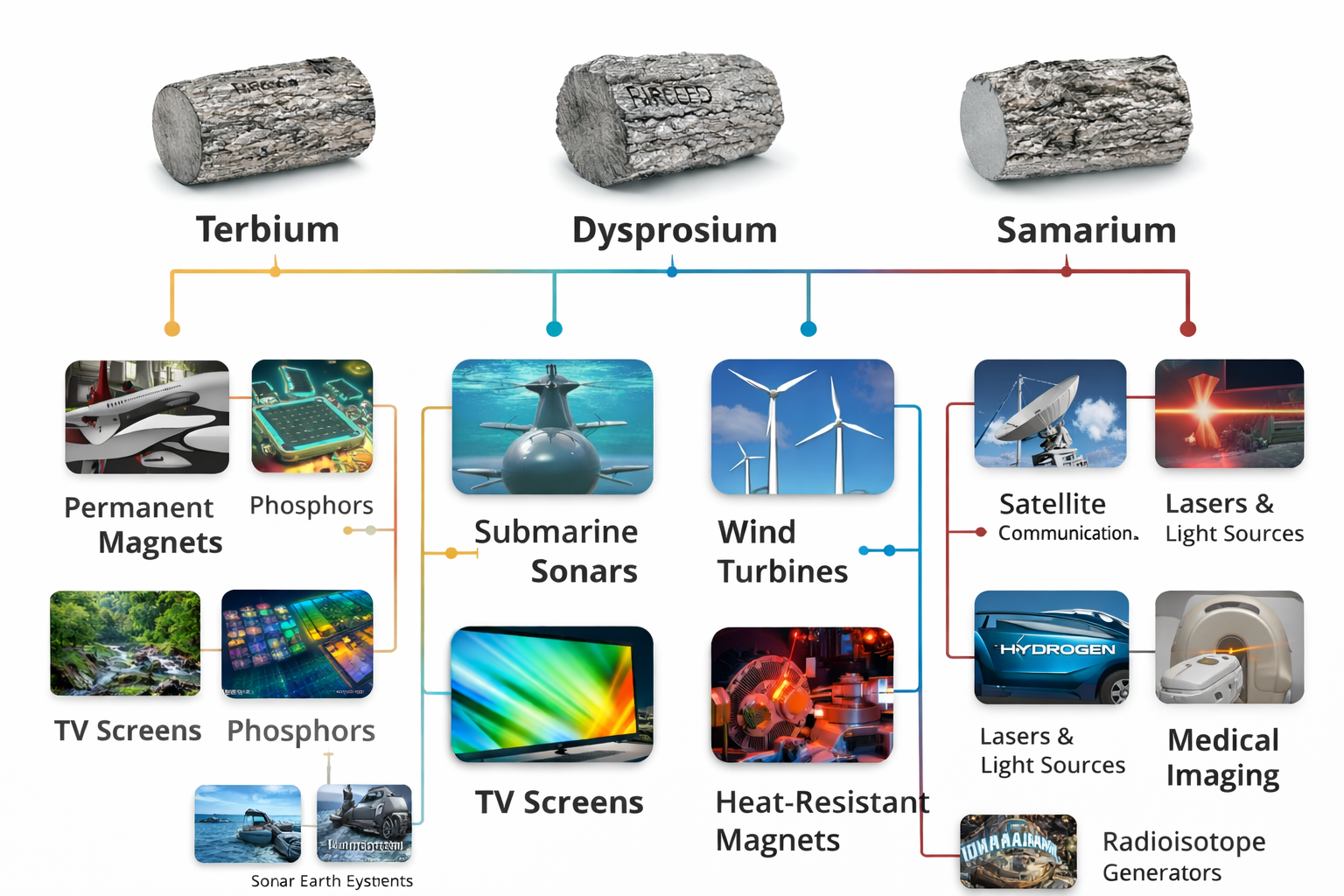
The global market for terbium and dysprosium is relatively small—estimated at only a few hundred tons. However, these elements are essential in key technologies: in permanent magnets, they ensure that magnetic strength is retained even at high temperatures. Terbium is also used in semiconductors, submarine sonar systems, and advanced weapons systems. In phosphors for TV screens, computer monitors, and smartphones, it provides a vivid green color.

Source: Institut für seltene Erden und Metalle AG
In 2023, China mined 255,000 tons of rare earth oxide equivalents (REO), accounting for nearly three-quarters of global production. However, these mixed rare earth oxides primarily consist of cerium and lanthanum—two elements that are abundant and inexpensive. As a result, one kilogram of lanthanum can be purchased for as little as €0.80. Heavy rare earth elements, by contrast, occur in much smaller proportions and are therefore significantly more expensive. Over the past twelve months, the price for one kilogram of terbium oxide (99.99% EXW EU) ranged between €2,840 and €4,330, while dysprosium (99.5% EXW EU) traded between €650 and €1,010 per kilogram.
China Outsources Environmental Problems
An indicator of the production volume of the more valuable heavy rare earth elements is the mining of ion-adsorption clays. These contain significantly higher concentrations than bastnäsite, monazite, and xenotime—the most commonly mined rare earth minerals. China therefore distinguishes between the extraction of light rare earth minerals and ion-adsorption clays. According to China’s Ministry of Industry, 19,150 tons of the latter were mined in 2023.
For a long time, China was able to meet its demand from its own deposits in the south. These deposits are not mined using conventional methods; instead, the material is extracted through in-situ leaching. This process involves first clearing entire hilltops of vegetation, then drilling holes into the slopes. A leaching solution—usually ammonium sulfate—is injected into these boreholes to dissolve the metals. At the base of the hill, the turquoise-blue solution that seeps through is collected in round basins for precipitation. The resulting material is then processed in smelting furnaces to produce a mixed oxide.

Although this method is less invasive than conventional open-pit mining, it poses significant environmental risks, particularly through contamination of soil and water with heavy metals such as arsenic, lead, and cadmium. As China’s domestic deposits became depleted and the government introduced stricter environmental regulations in response to increasingly evident negative impacts, mining activities gradually shifted to Myanmar from around 2010 onward. There, environmental regulations are weak and labor is inexpensive.
According to Chinese customs data, more than half of China’s rare earth imports currently come from its neighboring country. From Myanmar, China imports exclusively ion-adsorption clays—that is, heavy rare earth elements. In 2023, import volumes reached 41,700 tons, more than double China’s domestic production in the same year. According to an analysis by the Institute for Strategy and Policy–Myanmar, a Thai think tank, imports from Myanmar accounted for as much as two-thirds between 2017 and 2024.
Trump Considers Deal with Resistance Groups
This strategic vulnerability has not gone unnoticed in Washington. In late July 2025, Reuters reported that the U.S. government was exploring, in talks, ways to gain access to Myanmar’s rare earths and potentially cut China off from this key source, either partially or entirely. Could the activities of mercenaries such as U.S. citizen VanDyke and his Ukrainian associates—arrested in India—be connected to this?
Since the military coup in 2021, Myanmar has been engulfed in civil war. The junta, supported by China and Russia, overthrew the elected government of Nobel Peace Prize laureate Aung San Suu Kyi, ending a decade of tentative opening and democratization. Since then, the country ranks second to last in the global democracy index—behind even North Korea.
The junta now effectively controls only the regions of Yangon, Ayeyarwady, and the capital Naypyidaw. The rest of the country is affected by armed conflict involving more than 20 different groups, fighting with or against the military regime—and sometimes among themselves. The junta is largely isolated internationally. Russia is considered its most important ally and arms supplier, which may explain the increased presence of Ukrainian nationals.
China is also a key partner of the military junta. Myanmar plays a strategically important role in China’s Belt and Road Initiative. A central element is the China–Myanmar Economic Corridor, which provides China with the shortest route to the Indian Ocean. Equally important is the China–Myanmar pipeline, through which China imports oil and gas while bypassing the Strait of Malacca. Beijing has therefore adopted a pragmatic stance in the conflict—seeking not to endanger the pipeline while also maintaining access to Myanmar’s rare earth resources.
Between 2021 and 2024, rare earths worth approximately USD 3.6 billion were exported to China. The peak occurred in 2023, with exports totaling around USD 1.4 billion. Some observers suspect that China has been stockpiling these valuable metals. At that time, mining operations—concentrated in Kachin State and parts of Shan State along the Chinese border—were still largely controlled by the military junta or militias loyal to it.
Heavy Rare Earths Drive Conflict Dynamics
In October of last year, the balance of power shifted. The armed wing of the Kachin Independence Organization seized control of the entire mining region. The group now controls a significant share of global production of heavy rare earths. In the short term, this led to a shortage of terbium and dysprosium, nearly doubling their prices. China was forced to continue doing business with the resistance militias. Whether controlled by the military junta or ethnic groups, rare earth mining in Myanmar is linked to human rights abuses, and revenues from the sector are a major source of funding for the warring parties. This further fuels the civil war, destabilizing the entire region—including northeastern India, Laos, and northern Thailand.
The role of heavy rare earths in Myanmar’s conflict is reminiscent of Central Africa, where the extraction of tantalum, tin, tungsten, and gold in the border region between the Democratic Republic of the Congo, Rwanda, Burundi, and Uganda finances armed conflicts. However, while these so-called “3T” minerals are classified as conflict minerals and their direct import into the U.S. and EU is restricted, this is not the case for terbium and dysprosium. Although China is currently the sole buyer of Myanmar’s rare earth ores, a potential U.S. deal with armed groups could serve as leverage to improve mining conditions.
Given the widespread use of permanent magnets containing terbium and dysprosium, the question arises whether these metals should also be classified as conflict minerals. They are found in nearly all devices with electric motors—from washing machines and electronic toys to robots, fighter jets, and wind turbines.
Illegal mining activities have expanded rapidly since the 2021 coup. Using satellite imagery, the U.S. think tank Stimson Center has identified at least 549 irregular rare earth mining sites. Human rights organizations have raised alarms. According to Global Witness, there are reports of child labor in mining operations. The severe environmental pollution caused by illegal mining is also spilling over into neighboring countries. The Sai and Kok rivers flow into Thailand, where communities dependent on fishing and agriculture are already heavily affected. Their livelihoods are threatened by heavy metal contamination linked to rare earth and gold mining in Myanmar. Illegal mining is also spreading into Laos, where Chinese companies in particular are targeting rare earths and gold.
First Processing Capacities Outside China
Mining and processing of rare earths in China are tightly regulated by government production quotas. Recently, Beijing has significantly increased these quotas, lowering raw material prices and benefiting downstream industries—while rare earth producers are facing losses.
Rare earths from Myanmar are processed in China by the China Rare Earth Group (CREG), which now operates the country’s only smelter for heavy rare earths after acquiring facilities from Xiamen Tungsten Group and Guangdong Rare Earth Industry Group. Outside China, there are still no significant processing and separation capacities for heavy rare earths.
Initial steps in this direction are being taken by the Australian company Lynas Rare Earths. By mid-2025, its plant in Malaysia is reported to have successfully produced dysprosium and terbium oxides. In March of this year, the company also produced samarium oxide—a key material for military applications. Lynas is thus the first company outside China to produce heavy rare earths, although it has not disclosed production volumes.
Over the next two years, Lynas plans to expand its product range to include gadolinium (used as a contrast agent in MRI imaging), yttrium (for color displays, lasers, and high-temperature alloys), and lutetium (for cancer therapies and high-performance materials). Production will be supported by the expansion of its Malaysian facility, which is expected to reach an annual processing capacity of up to 5,000 tons of raw material. This material is sourced from Lynas’s Mount Weld mine in Australia, with plans to develop additional sources such as ion-adsorption clays in Malaysia.
The Canadian company Neo Performance Materials is also entering the heavy rare earth space. On Friday, it announced that it had produced its first batch of dysprosium and terbium at its Silmet facility in Estonia. Neo has signed a supply agreement with the U.S.-based company Energy Fuels Resources for mixed rare earth carbonate feedstock, with the first delivery made in July 2021.
Radioactive Waste Burdens Native American Communities
Energy Fuels operates the only currently active uranium processing facility in the United States, located in Utah. In recent years, the company has also processed rare earths from monazite mined in Georgia by the chemical company Chemours. However, monazite is rich in radioactive thorium, which is generated as a byproduct during processing. These residues are weakly radioactive but long-lived, making their storage costly and associated with environmental and health risks.
Dependence on China for heavy rare earths is unlikely to change significantly in the near future—even if Trump were to strike the highly unlikely deal with Myanmar’s militias. It will take several years to build sufficient processing capacity in Malaysia, the United States, and Europe, and for these facilities outside China to prove economically viable. And even then, the issue of radioactive waste remains—one that particularly affects Native American communities in Utah, whose reservations border Energy Fuels’ White Mesa Mill refinery.
ISE AG – April 2026
Arndt Uhlendorff